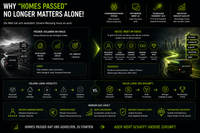
Why „Hommes Passed“ no Longer Matters Alone!!!
The shift from infrastructure expansion to revenue activation in FTTH networks
for years, the FTTH industry focused primarily on one core metric:
Homes Passed.
The logic was simple:
Build network footprint, increase coverage, create infrastructure value.
And for a long time, that approach worked.
But the market environment has fundamentally changed.
Today, many fiber operators across Europe are facing a new reality:
Built infrastructure alone no longer guarantees sustainable monetisation.
As FTTH markets mature, operators increasingly face:
- lower natural conversion rates,
- slower customer activation,
- rising acquisition costs,
- stronger competition,
- and increasing investor pressure on capital efficiency.
In this environment, the economic quality of a fiber footprint is no longer determined solely by how many homes are technically reachable.
Instead, the decisive question becomes:
How efficiently can built infrastructure be converted into sustainably activated revenue-generating households?
This is where the industry focus shifts from:
Homes Passed
to:
Homes Activated
and
Revenue Activation Velocity.
⸻
The growing monetisation gap!
Many operators today face a widening gap between:
- technically completed rollout areas,
- and economically activated customer clusters.
The result:
- delayed revenue recognition,
- weaker return on built fiber capex,
- operational inefficiencies,
- and underperforming expansion zones.
In many cases, the limiting factor is no longer construction itself.
The real challenge lies in the operational activation chain between:
- customer activation,
- technical qualification,
- field execution,
- and final service activation.
⸻
Why traditional models underperform ?
In many FTTH organisations, activation processes remain fragmented:
- sales partners focus on acquisition,
- technical teams focus on feasibility,
- construction partners focus on physical rollout,
- while monetisation responsibility often remains organisationally disconnected.
This creates operational leakage zones where:
- customers drop out,
- projects slow down,
- technical complexity increases,
- and activation momentum gets lost.
The consequence:
Built infrastructure remains economically underactivated.
⸻
The future belongs to integrated activation models
The next phase of FTTH evolution will not be defined solely by rollout speed.
It will be defined by:
operational integration efficiency.
Operators increasingly require:
- integrated activation models,
- technical prequalification,
- field execution coordination,
- KPI-based steering,
- and measurable activation performance.
The strategic objective is no longer simply:
build faster.
But rather:
monetise existing infrastructure more efficiently.
⸻
A new operational reality.
As investor expectations rise and infrastructure markets mature, the industry is entering a new phase:
Fiber infrastructure becomes valuable only when operationally activated at scale.
The winners of the next FTTH phase will likely not be the operators with the largest footprint alone —
but those with the highest activation efficiency per built cluster.